Showing posts with label Colombia. Show all posts

03 July 2017

My canine carry-on, Coco from Cartagena -- how did that happen?

Meeting Coco at the Cartagena airport
I started volunteering at an animal shelter when I spent a few months in Belize in 2014. At that time Judy & Beth, whom I met when they picked me up at the water taxi dock, brought me to my house-sit, and then said to me on leaving, "We'll pick you up at 8 am tomorrow; we're going to the shelter to walk dogs." Um, ok. I like dogs. I like to walk. I like to volunteer. Works for me!

Since then, every visit to Ambergris Caye has had me at Saga Humane Society getting weekly quality time walking some of the most lovable & adorable pooches around. And my consciousness was raised so that I also became aware of Cartagena Paws, an organization in another country I visit often, which helps the all too numerous street animals in that city.

Both Belize's Saga Humane Society and Colombia's Cartagena Paws work not only to help abandoned animals, but they of course want these dogs & cats to have forever homes too. Many times those willing & best able to adopt pets live in the US or Canada, and so the critters lucky enough to be adopted often need help getting to their new homes. This is where travelers like me (& you?) come in handy!

Packing for a Purpose with donations!!
When flying from the US to Belize or Colombia, I usually bring an extra suitcase filled with Pack For A Purpose donations for the local community. That leaves me "light handed" on my return to the US, and so it was a no brainer to volunteer to be a pet escort. Cartagena Paws happened to have the perfect fit for me this trip -- my first opportunity to serve -- as puppy Coco needed to get to his new mom in Maryland at the end of June.

Coco, his four brothers & their mom had been found in an abandoned lot, obviously neglected and in need of help. They all received medical care, vaccinations, etc, and ultimately found families in the US; there were a number of different flight volunteers in June flying them to California, New York, Massachusetts, & of course Maryland.

I met Coco & his foster dad (& foster terrier brother!) at the airport the day before our flight, so customs paperwork could be processed. I volunteered to foster Coco for his last night in Colombia so we could bond a bit before our long travel day -- what a cutie! After getting a huge number of licks from him at the airport, Coco followed my every step in the apartment. I would be at the kitchen sink and he would lie at my feet; if I went the two steps from there to the refrigerator, he got up to follow me; of course if I was sitting anywhere, he needed to be curled up next to me. Adorable!

On travel day, Coco happily got in to his pet carrier, where he would be spending most of the next 11 hours (poor guy!). He was a jewel -- slept nearly the whole time and there was never a peep out of him. We cleared security twice and I carried him with me through the scanner while his carrier went through the X-ray machine; Coco didn't even try to wiggle out of my arms. Because of a customs delay on arrival to Fort Lauderdale, we had a very tight connection and so the poor pup didn't get a potty break but still no complaints (or "accidents") at all!

When we got to Baltimore, my first concern (after meeting his new mom!) was to get Coco outside & out of the carrier so he could do his business; it had been a long day! We went out to the sidewalk and opened the carrier; Coco walked out, looked around, but was seemingly so overwhelmed by it all, that he walked right back in to the familiar & curled up in his carrier. Poor guy!

Coco with his new brother
Coco is now in a loving home in Maryland with two boxer siblings, having the time of his life. A happy ending for Coco!

Now I know that there are some who are probably wondering about a couple of things, as I have heard & had these questions myself.

Aren't there dogs & cats in the US who need to be adopted? Why are we flying in animals from other countries as pets? I volunteer with an SPCA in Maryland, which is always looking for families to adopt their animals, so it is ironic that I have brought a puppy from Colombia who was adopted by a family in Maryland. But I have also heard from friends that it can be much more challenging to adopt a pet in the US. Adopting overseas could be a faster & easier process for some, funnily enough. Others may feel more inspired to help a dog or cat from another country; isn't it great those animals too will also have loving homes? I thought there were good balanced arguments for both sides about this here. One of the 'against' arguments calls for "dealing with the causes [of stray animals], such as neutering, animal control, and owner education." Definitely in agreement and Saga in Belize, and other groups also, do this as well. [2019 note: Cartagena Paws has also started a spay/neuter program.]

Shouldn't we be helping people rather than animals? Shouldn't we be helping both? And in some ways by helping animals, you're helping people too. Belize's Saga Humane Society, for example, has an education program visiting schools to teach kids how animals should be treated & cared for (animal abuse is not uncommon, unfortunately). And by teaching these kids compassion for animals, they learn more about compassion in general, with the goal of having a more compassionate society overall. [2019 note: Cartagena Paws is fundraising towards an education program also.]

Other thoughts/comments welcome!

Interested in being a flight volunteer for a pet? You can read more about it here. There is a list of organizations around the world looking for flight volunteers here, although it is a limited list; there are definitely more such groups out there, including:

*South America: several in this post
*Belize: Saga in San Pedro, Ambergris Caye
*Mexico: Tails of Mexico and The Ranch in the Lake Chapala area
*Costa Rica
*Turks & Caicos
*Thailand: Soi Dog Foundation; there are two Facebook groups (one here and another here) for those flying from Thailand to anywhere in the world, although mainly to Europe and the US/Canada.
General flight volunteer needs in this Facebook group.
*Shenzhen, China: Karuna Rescue (needs flight volunteers out of Hong Kong)

Learn more about Cartagena Paws in this Colombia Calling podcast!


15 June 2017

A Delicious Night in a Colombian Jail

I have always been a bit curious about Cartagena’s women’s prison, located within the Old City walls just a half a block from the trendy Plaza San Diego (and a block from where I lived while teaching here). I have walked by the jail countless times, often seeing small signs of the women’s lives through the bars on the second floor above — sheets tied up to block the strong Caribbean sun, clothes hanging to dry, a hand of someone presumably gazing out at the sky above. The depressing sign above the entry states visitors are allowed Saturdays & Sundays, entering between 9 & noon and leaving by 3 pm. All a stark contrast to the charming architecture & Caribbean colors of most of the rest of the UNESCO world heritage site.

Reports state that the prison was built for 50 but now houses 180+ and is to be moved from its highly sought after (& high priced) walled city location; it is steps from the luxury Hotel Sofitel Santa Clara and numerous $$$$ restaurants.


"I believe in second chances"
Despite this potential imminent move of the Carcel de Mujeres de San Diego, Restaurante Interno opened its doors late last year and not only adds to the culinary offerings of the Old City, but is a prison rehabilitation program as well. It provides practical training for inmates so they have marketable skills upon release, plus funds other prison projects improving conditions & prospects for the inmates.

I was finally able to check out the restaurant last night & it was a delicious, while at times humbling, experience! The food was good and the setting pretty, despite the seemingly (although given the circumstances understandably) unwelcoming nature of the restaurant entrance -- a locked metal door which is opened and closed by a guard. The servers wear t-shirts that say "I believe in second chances" and plated food is passed to them from the kitchen through slots in a gate.

Top chefs donated recipes and helped train the women to prepare and cook them. A prison garden and bakery supply the restaurant, as well as provide additional training opportunities for the inmates. Those who work there earn (limited) funds to send home to families. Segundas oportunidades is written on the entry wall to the restaurant and referenced on the t-shirt backs of restaurant staff; "second chances" are being offered for these women.

For more information on this Cartagena restaurant, see the brief story on their site and also an AP article here. A quick search found similar type eateries in Italy & Britain too. Should you find yourself in any of these areas, give the restaurants a try! And maybe there are more? Please comment if you find one!

P.S. For those who are curious as to what the inside of the Cartagena women's prison looks like, see photos I found on Facebook here. 2018 update: video footage from the restaurant & inside the prison can be seen here.

30 September 2015

Need your luggage fixed? Recommendation for you here

Ah, I’m back “home” in Cartagena for a few weeks. It’s been fun reacquainting myself with the maze of Old City streets, drinking tropical fruit drinks, eating coconut rice, catching up with people, watching the Caribbean fisherman, and sweating in relishing the heat….


But more on all of that in a later post. What I may be most thrilled about is that I brought here with me two suitcases which had been deemed throwaways and they are now back in full working order!!

Excuse the “country dropping”, but while traveling in Europe last year, I used my sturdy Rick Steves roll aboard suitcase. In Spain, the rubber tread came off of one of the wheels. “Ay perdone señora, but I am sorry, that cannot be fixed” I was told at repair shops I visited. No biggie; I dealt with the crookedly rolling bag. 

In Italy, while running from one train to catch another, one of the suitcase “feet” fell off. “Mi dispiace, signora, no repair possible.” Now I had a bag that stood even more lopsided—if I forgot to stand it up by a wall, the bag was on the ground. Could be dangerous should an unsuspecting toddler walk by; I need to do something.

In the U.S., a call to the Rick Steves store said replacement wheels and feet were not available, but they’d be happy to sell me a new bag. “But it’s still functional!”, as a London friend of mine said. She was right….why are we often told that the best way to "fix" a broken item is to replace it? I knew just where it could be fixed: there are guys in Cartagena who have a street workshop right in front of the ATM I always used.

Fast forward to now and my spur of the moment trip to Colombia. Not only am I here to update myself for my vacation rental work, and all the reasons above, but another goal was to get my bag working like new again!! I had brought along my sister’s “unfixable” roll aboard as well. Sure enough, went to my former bank & right in front of that I found Luis & his father, working away. A day later I had two fully functional rolling carry-ons.

So my recommendation to you? Come to Cartagena for sure — it’s a UNESCO world heritage site well worth a visit, easy to get to, & the exchange rate is currently in most tourists' favor. But as a bonus, bring your broken luggage along with you, visit Talabartería Luis & head home with a “new” bag!


Luis's father told me he has been working here for some 40 years!
They fix luggage, briefcases, purses & leather paintings. Located in front of Davivienda bank on Panama St

23 March 2014

Still here...!

Ah, it's March, must be time for my annual blogpost. Yes, I have turned into not much of a blogger, eh?! But I'm still here, in the "south" (ie, Latin America)!

As a brief update:

I spent basically all of 2012 & 2013 living in Cartagena, Colombia, where I taught English at the Centro Colombo Americano. It was the first time I'd ever taught & I really enjoyed it; I'm also glad I had taken the one month intense ESL teaching certificate program (CELTA) in San Francisco before I left there--it helped a lot.

At Ciudad Perdida with niece Carolin & friend Luisa!
I was able to travel quite a bit in Colombia, both with friends (some living in Colombia, some who came to visit) and solo. It's a hugely diverse & fascinating country -- I highly recommend it! Just to mention some highlights: traveling with Spanish friends who live in Colombia (& whom I met during my junior year in Madrid 1981-82); when my "German niece" (from the family I lived with in Germany in 1978-79!) came to visit & we did the 5 day Ciudad Perdida hike with friends; and also when my sister & her 11 year old son visited me in Cartagena--my nephew said it was the best week of his life. I love being an aunt! :)

What 11 year old (& 50 something year olds!) wouldn't love a mud volcano?!
Surprisingly, there was so much to see & do in Colombia I didn't venture much outside of that country, beyond trips back "home" (which could mean a few places) for special events. But I did get to Peru for a couple of weeks--Machu Picchu and the Sacred Valley are all that they say it is and more--and Ecuador for a month. While in Ecuador last July, I volunteered for two weeks on the coast in the fishing village of Puerto López, helping with a Spanish reading program in elementary schools, an after school kids' club, and teaching English.

When I decided that I was ready to move on from Colombia (after all, my 6 week stay there turned into over 2 years!!), I decided to go back to Puerto López to volunteer again. So here I am for a couple of months! I'll be moving on again soon, but perhaps I'll be back to Ecuador. I haven't yet made it to the Galapagos & that is definitely on my list.

And no, I haven't turned independently wealthy. I was lucky enough to get the opportunity to help out with some vacation rental apartments, something I can do totally online. I started doing this with some apartments located in Cartagena's Walled City in 2012, and a few months ago was able to add on renting out vacation condos in Ambergris Caye, Belize. Check out my webpages, always works-in-progress:


The current plan is to travel more while maintaining the "rental business" thanks to the internet. Know anyone planning to visit Colombia or Belize? Please share my links! :)

Will try to make sure it's not another year before I update things again...meanwhile, I'll catch you on the road! (in Latin America? Europe? the U.S.? Who knows!!) Let the adventure continue.....Hasta pronto!

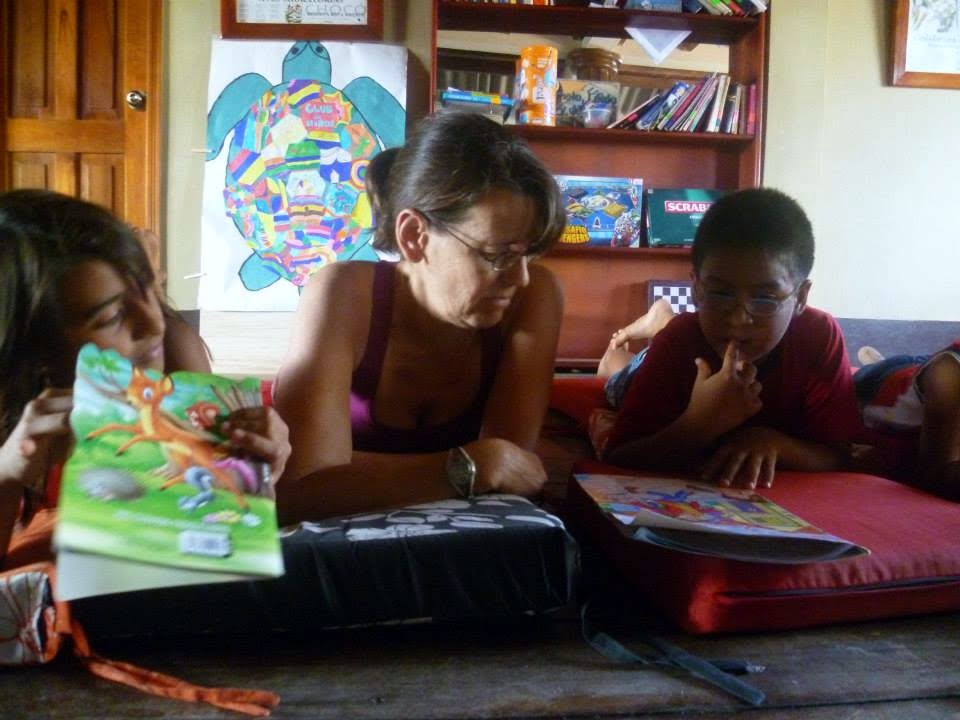
Teaching an English class on the beach with a fresh tropical juice in Puerto López!


Reading with kids in Puerto López!

31 March 2013

You eat ants?

Wow, it's Easter again, or Semana Santa (Holy Week) as they call it in Spanish-speaking countries. Last Semana Santa I traveled to the desert of La Guajira, northeast of Cartagena, and then a bit inland to Mompós, which is famous for it's Holy Week processions. I never thought I'd still be in Colombia a year later, but here I am, still with lots to do and see!
Cabrera town square
It was arranged so that we wouldn't have to teach classes during Semana Santa at the Centro Colombo Americano. While the school was open for a couple of days during the week, we "overtaught" by several minutes each class period in the three weeks coming up to Semana Santa so we could make up time and take the entire week off. Fine by me! I headed out last Saturday night with a friend on a 13 hour overnight bus trip south to Bucaramanga, capital of the Santander department. From there we connected to another bus for a 2.5 hour trip to San Gil, "adventure sports capital" of Colombia, and then continued on to our third bus for an hour's trip to Cabrera, a small colonial pueblo. I had planned a 3-4 day hiking trip from small town to small town outside of San Gil, culminating with a hike down--and then up--the Chicamocha Canyon. 

It not only takes a long time to get anyplace here, it's also hard to get information sometimes. So despite the fact that several guide books/online sites spoke about a 2-4 day hike between these small towns, information on the actual routes and accommodations in each spot was difficult to find -- for example, despite multiple inquiries to various tourist type places, I hadn't been able to find out if the pueblo of Cabrera had any kind of accommodations at all. However, upon hearing that we were looking for a place to stay, our friendly San Gil-to- Cabrera bus driver immediately called someone in the pueblo and had rooms for us booked at the one place in town. I needn't have worried!
Playing tejo


Cabrera was cute! The few kids who were playing around the main square practiced their English with us: "Hello!" "Hi!" "How are you?" We also got to see the only other thing happening in town that night: a "tejo" game, a national sport based on an indigenous game. In a way it's kind of like horseshoes (or for the younger crowd, cornhole) -- you have to throw a little metal disc into a box of clay. In the middle of the box of clay is gunpowder, and if you hit it right you set off a little explosion. Fun!! Add to this the fact that everyone drinks beer while playing, and you have a *really* fun time. Alcohol plus gunpowder--gotta love it!?!?
Camino Real

We started our trek the next day along the Camino Real, a trail originally used by the indigenous Guane people and then later by the Spanish. It was rebuilt in the late 1800s and still pretty well maintained. Our first 30 minutes or so of the trail was pretty much straight up -- great way to start the day! The plan was to hike ~2.5 hours to Barichara, known as "Colombia's prettiest town", but we ran into some locals partway along who gave us a ride half way to Barichara, and who were we to say no?


Melanie & the "chismosera"
Along with these locals, who owned an artisan shop in Barichara, we met another super nice couple who own a family vacation home in the town. They invited us in for a glass of wine and to see their fabulously renovated home, complete with "chismosera" (if I'm remembering the word correctly?? it comes from "gossip"), which is a built in little nook just below and inside the windows that allow you to easily see what's going on in the street--this way you can of course keep up with what your neighbors are up to!!


Unfortunately, not edible
One thing that Barichara is well-known for is their edible ANTS! As Mowgli said, "You eat ants?" Yes, ants: "hormigas culonas" or "big assed ants" (literally). I knew it was something that I *should* try but it wasn't really something that I *wanted* to try. And I was in Barichara for ant season. When it rains, they come out of hiding the next day, and then they're scooped up and toasted; supposedly they taste like popcorn. It rained heavily the night before we hiked to Barichara and stopped that morning...yikes, I was in "luck." But then I learned that they wouldn't emerge until the day following the big rain, and after that they'd need a day to toast them and get them to their delectable goodness. So no, I didn't eat ants; drat (?), a missed opportunity!


Leaving Barichara
After Barichara, we continued the next day to Guane, another town "lost in time", where my travel buddy Melanie decided to hitch a ride to the next destination. We had met up with a local guide there who was the support vehicle for 3 guys who were hiking from Cabrera that morning (where we had started 2 days prior). He offered to take Melanie to Villanueva, our destination that day, and suggested I wait for the 3 guys and hike from Guane to Villanueva with them. Fortunately, I decided not to wait for the 3 guys, thinking they'd likely catch up to me anyway on the trail. Turns out these three guys were part of an adventure racing team doing everything for time, so they would not have wanted me as their hiking companion! But in any event, these guys decided it was too hot & got a ride most of the way to Villanueva--hey, "no wimps", guys!! (After hiking 3 hours from Guane to Villanueva, I still arrived just before the adventure racers anyway!)

Planting seeds by hand
Melanie chose to bus it back to civilization from Villanueva, so I set off shortly after dawn on Wednesday to avoid as much of the heat as possible. This would be my last hiking day and I had 7-8 hours ahead of me, which included a descent into a canyon and then the climb out. Just on the edge of town I ran into a man carrying empty containers and asked him to make sure I was heading out the right way to Jordán, my next destination (a ghost town at the bottom of the Chicamocha Canyon). He said yes and we walked along about 10 minutes together. He heads out this way every morning "for exercise"....and to get water so that he has some at his home. I passed several people out in the fields, some even planting seeds by hand (beans and tobacco are the big crops in this area I was told). The previous day on the trail I had seen someone carrying a case of beer (essentials!!) on his back up the trail from Guane. It is amazing what the day to day is like for many people here, and even living here I am still constantly amazed.

After about an hour I sat down by the side of the road to have a little breakfast. As I was eating, a hiker (obviously a foreigner) walked by & asked if I was going to Jordán. "Yes! We'll see each other in Jordán or on the road!" I finished my breakfast & caught up with the guy a short ways later as he was asking directions of a local. Turns out Bert was a Swiss grad student, and while we started speaking in Spanish, I asked him if he wanted to speak Spanish, English or German. At first when he just heard Spanish or English, he chose Spanish; but then when he heard he had a 3rd choice, he said, "You speak German?" "Yes" "Why??" "Gute Frage!" :) So we spoke German. (While it is hard for me to switch from one language to another, in the past several months I've had more opportunities to speak German while living in Colombia, so it's getting easier. Still there are times when my brain knows it should speak "foreign" but pops out a German word instead of Spanish, or vice versa, and I get some funny looks. But it's getting better....!)

Checking out the descent...
At one point we were advised to get off the "road" (really a jeep track") and take the hiking trail down the canyon. You get directions from the locals which don't always make sense to you (given the language obstacle and unfamiliar territory) until you get to the place they may have described, and then you have to remember what they said about it. For example, one woman we asked was telling us what to do when we got to the "cabrera", which I only realized later meant "goat herd" (not a word I use a lot!), so I didn't even realize what she was talking about until I saw all the goats, and then I had to remember what she said to do once we got to the goats. But always a fun challenge, and from where we found the "cabrera", we had a great view of the canyon--what we were about to go down and the other side that we'd be going up.

The hike down was fine--not a lot of shade but some neat cactii, birds (vultures!) flying around, a snake even. Once at the bottom we passed a "caiman" farm; we chose not to enter but it also brought back up one of those "Oh, I thought someone *did* say something about caimans & I thought maybe I misheard." Nope, alligators. Presumably not native.


Jordán itself really was pretty much of a ghost town. We stopped at the one shop that was open & got cold drinks. Funnily enough, the display case in the shop was full of different kinds of what appeared to be freshly baked breads, rolls, etc, with racks of pans filled with balls of dough that were ready to be baked should the supply need to be replenished. I don't know who bought or ate all this bread, because 90% of the few buildings in town seemed to be abandoned or closed down and we didn't see more than a dozen people wandering around. We were directed to the one place we could get lunch: cross the bridge & stop at the house at the other side, the woman there will make you a meal. And she did.
On the bridge in Jordán


After our meal in Jordán, we headed up the trail that went up the other side of the canyon. We were going to go up some 3000 feet in I don't know how many miles; my written guide said it would be a 2 hour hike if fresh or a 3 hour hike if you'd started from Villanueva that morning (4.5 hiking hours ago). There were lots of switchbacks so in reality it wasn't that bad, but it was a constant ascent and I had my pack filled with my possessions for the week on my back. And I am not in Ironman shape!! I was dragging a bit and stopped after 30 minutes, telling Bert to go on, but he said he'd hang. After another half hour we stopped again & he offered to switch packs. I said ok, picked up his & he asked, "do you notice a difference?" while at the same time he picked up mine and said "oh, yeah, there is a difference." His was filled with helium; mine not quite. He carried mine the rest of the way which was great for me--we did end up reaching the top in 2 hours which I was pretty happy about, mainly because it meant we were DONE! :)

At the top was Los Santos, a small town. I had planned to overnight there and take the bus in to Bucaramanga the next morning. During the week I had heard rumors that some bus stations were closed from Thursday afternoon to Friday afternoon of Holy Week (Maundy Thursday to Good Friday) but kind of found that hard to believe since it was also touted as the most popular time to travel--how could they close the bus stations down during that time? In Los Santos I also saw a sign that announced the local buses would be running all day Thursday & Friday so I really thought the intra city buses would be too somehow. Ideally for me would be if I could check out Bucaramanga during the day on Thursday & take an overnight bus that night to Cartagena, arriving "home" on Friday morning.

Getting ready for Easter processions

However, all queries confirmed that there would be no bus back to Cartagena Thursday; the bus station would be closed from mid-day to mid-day Friday. Crazy that after a year and a half here, I was surprised by that. Ah well, just another something learned!! So I decided to explore Bucaramanga, "the city of parks", on Thursday. Well, turns out that because of Maundy Thursday, just about everything was closed in Bucaramanga, museums included. I was able to check out the parks as well as the churches, where everyone was getting their floats of Jesus, Mary, etc, ready for the evening processions--it is pretty incredible what they do. (See my post from Holy Week 2012.)

Girón's main square


The next day, needing to fill time until the first bus left later that evening, I headed to Girón, another picturesque colonial pueblo about 5 miles from Bucaramanga. Turns out a lot of people walk to Girón from Bucaramanga on Good Friday so I joined the crowd--and this crowd also meant that the picturesque little pueblo was jam packed. But it was cute!


Click here for complete photos of the week. 
Click here for a map showing you the different places mentioned in the trip.

08 March 2013

Chocolate, flowers & kisses!

It's International Women's Day! Who knew? I never heard about it much I don't think before I lived in Colombia, but it's widely celebrated here. And it's today! I got chocolate, flowers & kisses (ok, one....on the cheek) from students. Not bad.

Here are some of Cartagena's celebrated women (many thanks to This is Cartagena for some of these photos):
La India Catalina: now a well-known symbol of Cartagena as well as Cartagena's International Film Festival, she was an indigenous woman kidnapped by the Spanish in the early 1500s from this area. Twenty years later she returned with the Spanish and served as an interpreter in helping to pacify the various tribes here. There is of course a bit of controversy surrounding her. Wasn't she really just a traitor? Did she really look like this statue--tall and slim--while all the other indigenous people were short an stocky?

La India Catalina stands right outside the old city walls, and just about all local city buses pass by here. Poor Catalina, she's normally looking out over some kind of urban transport chaos!

Gertrude, a sculpture by famed Colombian artist Fernando Botero, is more commonly known as "La Gordita", or "the fat woman." However, subjects painted and sculpted by Botero are not fat, but "voluminous." Gertrude is displayed in the Plaza Santo Domingo in the heart of the old city, a great place to have an evening drink at one of the many outdoor restaurants. In the maze that is the Old City, she's also handy to use as a place to meet (everyone can find her) or as a way to give directions: "If you're in the Plaza Santo Domingo, follow La Gordita's feet and go a block, then turn right."

"Noli Me Tangere" says this woman facing the location of Cartagena's old port. This is Cartagena roughly translates it to, "Back off, pirates! I've got this covered." :) Not bad, not bad. In colonial times, Cartagena stored a lot of the Spanish empire's riches and was often the site of enemy attack.

La Palenquera statue stands along the waterfront outside the old city, with the Bocagrande Peninsula in the background. As mentioned in previous posts, the women of Palenque, a pueblo outside of Cartagena originally founded by escaped slaves, have become a symbol of Cartagena. They wear brightly colored dresses and sell fruit and sweets carried in large bowls on their heads throughout the walled city.

Above is Maria, the aunt of one of my students, with my mother and me in January. Those bowls are *heavy* and the women normally carry them on their heads...I don't know how they do it!

Feliz Día--Happy Women's Day!

19 October 2012

Bocachica Revisited

Our group led by our fearless guide on the left!

Last weekend was a holiday weekend (Dia de la Raza, aka Columbus Day in the U.S., was celebrated on the Monday) and the occasion to return to nearby places I'd already been to but wanted to get to know better. San Basilio de Palenque was one place; Bocachica and the Island of Tierrabomba was another.

I really wanted to go for a long hike on the island but at the tourist office was told that wasn't possible. But then I learned that the parents of one of my students was from Bocachica; I told her that I wanted to go on a  l o n g  hike, like from one end of the island to another, and asked her if it could be done. She said of course and arranged for someone to lead us.
Bocachica Foto by Norell

So, 8 of us (3 Colombians, a Colombian-American, 2 Yanks, a Mexican-American, & a German; love the international groups!) met up on Monday morning at 8:30. Of course the trip to Bocachica was only 20 minutes by boat, but for a variety of reasons, we didn't get there til 10:30. This is Colombia! 

Fort San Angel Rafael
We met our guide, German, at his home. He is a native of Bocachica & is involved with an organization that's working to preserve the old Spanish forts & ruins on the island. He was really informative & a very nice guy. There are 1600 people who live on the island in 4 small communities, all very poor. What is happening though of course is that the wealthy (individuals and companies) are buying up some parts of the island & during the course of our day we all of a sudden came across an area where there were luxury homes & hotel like places right on the water. What a contrast. In addition, the Colombian government owns some of the land there & a naval base, currently located on some prime real estate in Cartagena's Bocagrande area, will be moved to the island in the near future.
BATS!! Foto by Norell

German started out by taking us through the town of Bocachica, up a hill to a fort called San Angel Rafael. The fort had a really nice view all around, had been restored about 12 years ago, & had an escape tunnel that led down to the beach! We didn't escape. We entered just the opening of the tunnel and encountered BATS which was kind of creepy, although three of the local girls who followed us in to the fort had no qualms about going through all of the tunnels that we had been a bit nervous about. After enjoying the history & the view, we wandered down to the other fort that I'd already seen during my last trip. I was starting to worry that I wasn't going to see new parts of the island or get my long hike in, despite the fact that German had said a few times "get ready to WALK!" I didn't need to fear...

Blowhole!
Once we left that other fort, we started to really hike. We went all along a black coral bedded coast and passed some other old Spanish defense battery ruins, a blowhole where water at times shoots up to 10 meters high, as well as luxury homes. It did seem a little disconcerting how the luxury homes contrasted with the houses in the villages; it was apparent, too, that the fences built around these homes that reached nearly to the water had blocked off paths that previously had been used by the locals. But the coast was gorgeous....

After lunch & a quick dip for some, we started heading inland and up. This is the rainy season on the Caribbean coast, which means that (normally) brief but heavy rainstorms are fairly frequent. We connected with the one road (dirt) that went across the island, which of course was very muddy due to the rains. A few people on motorcycles were coming at us from the other direction and were having a hard time getting through; the smart guy on the burro had no trouble at all though!
We're going to get muddy!

Our goal was another small village on the "Cartagena" side of the island, from which we'd see a view of the city and be able to get a boat back home. We made it there at about 5 pm, 7 hours after we started. One of my fellow hikers from Cartagena said that it was the best hike he'd ever done. We were muddy and sore, but it was really good, beautiful, and interesting. 

From where we had arrived, we had a great view of the Cartagena skyline. In the foreground, just below where we were standing on Tierrabomba Island, you could see the very humble homes that people live in, then came the bay, then the luxury high rises of Cartagena. The discrepancy is always shocking. Wikipedia cites a World Bank study saying that Colombia is "among the most unequal Latin American countries in terms of wealth distribution" and a recent article in the local paper said that the GINI index (which measures wealth inequality) had risen by 10% in Cartagena in the past 16 years. That inequality was glaringly obvious to me this weekend.
Compare: homes in the foreground with those in the background

I got my hike in, but got a lot more too.


For more photos of Bocachica and Tierrabomba Island, click here.

17 October 2012

Back to Palenque for the Drum Festival!

Palenque street (photo:ElUniversal)
I was just back in San Basilio de Palenque! In my other post about this pueblo I mentioned there's a drum festival every October; it was last weekend and I was invited on a day trip with a group from my old Spanish language school. We took an air conditioned van for the hour trip between Cartagena & Palenque--not as adventurous as last time but more comfortable, plus I got to meet a number of new people (mostly travelers), some here for just a few weeks & some for much longer. 


Palenquero sweets
Almost as soon as I stepped out of the group van after we arrived, I ran into a student of mine who'd been in one of my classes for the September cycle & who was from Palenque. It was great to have him tell us about his town and the women of Palenque ("Palenqueras"), who have become symbols of Cartagena. Their becoming Cartagena symbols came about relatively recently & was the result of a lot of struggles by these women. They've traditionally sold fruit & sweets that they carry around in the bowls on their heads, but they were having a hard time being able to do it in the old city of Cartagena. It was only in about 1990 that they were finally given permission to do so, but then there were also certain regulations imposed on hygiene, etc., which all agreed that was not a bad thing, but also they were asked to wear the colorful dresses, which some consider costumes, as they are not a Palenque tradition.
Our lunch cooking outside!

While the homes in Palenque are very humble (many don't have indoor plumbing, have outdoor kitchens and dirt floors), many Palenquero parents work hard so that their children don't have to "work from the bowl", as the women traditionally do, or "work with a machete" in the fields as the men usually do. My student is one of those whose parents have stressed the importance of education; he and his siblings are all pursuing university degrees or have professional careers.


Her hairstyle took about 5 hours to do.
I revisited the parts of the village I'd visited the last time and wandered further on the small streets. We listened to a talk on the various hairstyles of the Palenque women and what they meant--I didn't realize that different hairstyles were worn for different occasions or had different meanings. And I realized they were likely time consuming but didn't think it might take several hours to get your hair done! In addition, there were various dance and music groups performing at various times of the day so we were well entertained & cultured.


Gracias, Ronal!
By not staying overnight, I missed the Sunday morning 4 am wake up call. A colleague said that the whole town was awoken to the beating of drums and everyone gathered to sing. She said it was quite impressive, although I think I was happy to be in my bed in Cartagena!


More photos from the Drum Festival Day in Palenque found here.

23 September 2012

Cannons, Carriages, Chivas, Carts & "Cometas"

The cannons are a great place to hang out!
When I look out of my apartment, I have a direct view to the top of the old city wall. Of course, being the protector of Cartagena, the wall was armed with cannons, some of which are still there. The last part of the wall to be built was called "Las Bóvedas," 23 large vaults originally used to house military while protecting the city, but which are currently nice craft shops. My apartment is not far from Las Bóvedas, a popular tourist destination, and so I often get to hear the clip clop of the horse carriage tours that people take in the walled city; hearing that you could almost imagine what it might have been like when horses were the only mode of transportation. But then along comes the next popular way to tour Cartagena: the Chiva party bus with their music & cheering party people. Sure, I did a "Rumba en Chiva" during the November Parties last year but hmmm....never thought about the people who lived along the route :). Well they end by 10 or 11 so it's not really so bad, and they definitely DO sound like they're having fun!
Clip clopping towards Las Bóvedas

Beyond the clip clopping and the "rumbas", there's a lot more street life to listen to--the fruit & vegetable vendors pushing their carts and calling out their goods and prices (papaya! papaya! a mil a mil a mil a mil!); the newspaper guy telling you what paper he's hawking; the guy pedaling his pedi-cart selling rolls who bangs on the metal top to let you know he's there; there are actually different types of vendors who have different patterns of "banging", but I've yet to successfully differentiate one pattern from another--I need to pay better attention! I do, however, have my basket ready with a rope tied to it. When I hear someone coming by selling what I want, I can now go to the balcony, call down, negotiate the price, pass down my money and bring up my purchase. Haven't done it yet, but I'm prepared!!


Let's go fly a kite!
And it's kite season!! There are tons of "cometas"to be seen out my window recently. There have always been a few but it seems to be more lately. I had noticed them across the wall but it never occurred to me to see where the kite party was really happening til I noticed another friend's blog post about it. So I went out a different way & lo and behold, there was a huge kite party going on! I need to alter my route more so I don't miss out on stuff like this!

More kite flying photos here.

I'm in a horse carriage here!