27 May 2012

Here's mud in your eye!

At the castle
San Felipe Castle viewed from Manga, just outside the old city
I took advantage of my former TNT colleague Frances's weeklong visit to do some things I hadn't done at all or since my initial visit to Cartagena 3 years ago! Not only does Cartagena have a 400 year old wall that encircles the old part of the city, there are also various defensive forts around the city leftover from colonial times. Frances and I visited the famed San Felipe "Castle" where I learned that George Washington's older half-brother Lawrence had been among the British troops that attacked this fort in 1741. He was there as a colonist who had volunteered to fight with the British navy, led by an Admiral Vernon. Later, when Lawrence inherited a Virginia estate, he renamed it Mount Vernon, after this admiral whom he admired. We Yanks now know Mount Vernon as George Washington's plantation home. Funny how surprising connections like this one come up; who would have thought there was a connection between Cartagena and Mount Vernon?

Enjoying a typical lunch at Playa Blanca: fish, coconut rice, & fried plantains
But I digress....back to the fortifications! This castle is readily seen from various points in Cartagena. It truly is impressive all of the huge walls and forts that were built around this city. I'm working on visiting more of them as well as learning more about their history.

We also took a day trip out to the Rosary Islands, a group of 27 islands which apparently from above look like they are linked together like a rosary. It is a protected area with some good snorkeling. We happened to go on the one day in the 6 months of my stay in Cartagena that it was cloudy (and it even rained), so the visibility for the snorkeling could have been better, but still it was good seeing colorful fish, coral, and touching a sea cucumber (icky feeling!!) . We then spent a few hours on a nice beach out in that direction, Playa Blanca, which was jam packed for the three-day weekend. Who knew that so many vendors could be around offering you so many things...jewelry, water, food, there were even "bars" in wheelbarrows; they'd make you a cold drink in nothing flat. Coco Loco, anyone?

Just floating....
The next day was the ultimate in Unique Things to do Around Cartagena: a dip in a mud volcano! The Totumo Mud Volcano is only about a 40 minute trip outside the city but I hadn't yet been; a group of us went and it was pretty surreal. You are literally floating in what they say is an over 2500 foot deep pool of mud. You have the option of getting a brief massage while floating on your back (& then your stomach, keep your face up!) and can then hang out in the "bath" as long as you like. Later, they wipe you down as you get out and then you hop into the lake to get cleaned off, with the help of local women if you like (who are very aggressive in getting you cleaned up, your suit doesn't stay on with them!!).

And I did get mud in my eye. My advice is: don't! (Although the people at the volcano are experienced in helping you get it out should it happen....still, it's sore for a few days!)
We are avatars!
(Which one am I?!)


More photos can be seen here.

13 April 2012

Holy Week in Colombia

Typical La Guajira dwelling with burros out front
Holy smokes, what have I been up to? I know, you've probably all been wondering...it's been so long since my last post! Well, will try to catch you up on the key happenings bit by bit, but for now will tell you about my Holy Week, "Semana Santa", or Easter week, in Colombia. We were originally to work on the Monday & Tuesday that week, but about 10 days prior my school decided to close for the week, as apparently often people travel. We will make up the missed days by adding a few minutes to each class that remains for the 4 week cycle. I decided to take advantage of a last minute full week off.

Desert "toll station"!
I ended up traveling with a few women first to a remote region of northeastern Colombia called La Guajira (gwa-heer-a) on a 3-day organized tour, and then to Mompós, a "town that time forgot" inland from Cartagena, which is famous for its Easter celebration. See this map of our week's route; it's not exact but close enough. As you can see we logged about 1900 km or 1200 miles, and Google Maps calculates it out to be 2.5 days of travel time. You may think that sounds like an error, but with many dirt roads via van, bus & 4WD; a lot of driving through the desert in a 4WD; and a couple of ferry crossings, it may be about right! But it was an experience.

Wayuu gas station, Uribia
La Guajira is largely unvisited and uninhabited but known for its beautiful desert landscape and indigenous people, the largest group being the Wayuu. We spent two nights at a rustic "homestead" like facility with spaces for tents, open-air hammocks (which my traveling partners stayed in; it's a popular sleeping option in Colombia), and small rooms with beds (which I had; guess I'm getting old). A Wayuu family owned the facilities but it was run by an ecotour group, who seemed less keen on expanding the facilities and hosting more people than the Wayuu, for obvious reasons! (But I think the owners won out!) We had fabulous meals of goat, lobster, fish, and chicken, all raised or caught right within feet of the dining area.

Making friends :)
I love the desert and have in recent years been to amazing desert areas in Utah, Arizona, Death Valley, etc., and have had my jaw drop in each place. This was another such area, different, yet beautiful, and having a desert along the coast was breathtakingly gorgeous. The Wayuu live in mud and stick houses, raise goats (which are running all over the place seemingly wild, yet somehow each Wayuu family knows which goat is theirs vs their "neighbor's" and the goats automatically go "home" to their correct corral), fish, some work with tourists such as at our facility, among other things. I don't quite understand how it all works but somehow I think they also have almost a monopoly on dispensing gas in the region, as for cars/trucks. They have "gas stations", really areas with lots of ~20 gallon gas cans, funnels & hoses. In some areas that's the only place you can get gas; there are no conventional gas stations.

At the northernmost point of South America
In driving through the desert, some Wayuu kids also set up "toll" stations; they'd string a rope or chain across a couple of cacti, blocking the road and would also put up blocks so a car couldn't drive around the toll area. You'd have to give them change (about 25c) before they'd drop the rope & let you pass. Amusing in some ways for those of us tourists although it likely gets old for the tour guides driving through the region all the time.

Besides the ever-present goats as well as random donkeys roaming the region, we also saw fabulous birds (including a huge flock of flamingos from a distance), iguanas, and the biggest darn grasshoppers I've ever seen. They were amazingly colorful and the size of a small bird; here's a photo from another's person's blog of one.

Anyway we did a bit of walking, beaching, sand dune running, body surfing, and learning about another region and people of Colombia. It was a quick but great trip!

Sunset, Taroa Sand Dune
From there, I headed with two others to Mompós. Traveling between places when going by land is not always easy, but that is part of the adventure also. Our La Guajira tour was to leave us in Riohacha, the main city of the region, and we planned to overnight in a city between Riohacha and Mompós. However, the last bus to Valledupar, our overnighting point, left Riohacha prior to our return, and so we had planned to get a "colectivo" for the 3 hour trip from Riohacha to Valledupar. A "colectivo" is essentially a shared taxi from one point to another--there's a set price for the full trip and it's divided by 4. If only 3 of you show up and you want to chip in the amount for the 4th (non-existent) person, you can, or you can wait & hope a 4th person shows up. "Colectivos" are normal forms of commuting transport within Cartagena; I was learning they were also normal forms of transportation between oft-traveled cities or towns. We were waiting in the appointed area for a colectivo to Valledupar, when a "real" bus stopped in front of us; someone got out, said he was going to Valledupar & did we want a ride. We agreed on a price and hopped in to the empty bus. He stopped at a few other points along the way and collected more passengers but we had a nice air conditioned bus almost to ourselves and arrived in Valledupar in style & for less than anticipated.
Just behind where I stayed

Contrasting this trip was our van ride the next day from Valledupar to Mompós. I blew this one, but to make a long story short we ended up paying more for a substandard trip--too many people packed in to a van with no AC, a chicken in a box, lots of dust blowing in, the van assistant traveling with our luggage on top of the van, and we, the gringas, paid more than anyone else for the trip. We crossed on a ferry that was really just a few planks hammered together on top of some old boats; we the gringas climbed out of the van while on the short but seemingly perilous crossing while the Colombians still packed in the van wondered why we'd gotten out. Ah well, we made it to Mompós with stories to tell!

Our dubious ferry ride while traveling by van to Mompos
Mompós is a beautiful little town that's worth the (no matter how you do it, as you have to travel dirt roads & take a shady looking ferry) less-than-comfortable trip there. It's very walkable, has beautiful architecture, at night everyone sits outside in their Momposian rocking chairs, and it's also been named a UNESCO World Heritage Site. We had a great meal sitting by the Magdalena River, which is the principal river of Colombia. Mompós used to be an important commercial port on the Magdalena, but then a hundred years ago this branch of the river silted up and transport shifted. Mompós hasn't changed since that shift, keeping its early 20th century feel.

Lunch in Mompos with our new friend Santiago and my student Nubia
That evening we saw our first of the famous Mompós Holy Week processions, which have been going on for over 400 years. They start at 6 pm and end sometime in the wee hours of the morning, having traveled a grand total of what can't be more than a half mile up one street & back another. But they march very slowly, taking one step backwards for every two small steps forward, carrying platforms with statues of various saints, etc., which have been around since colonial times. The Holy Thursday procession features the 12 stations of the cross. The "carriers" are honored by being chosen, but they are also dressed in several layers, all packed together, working hard carrying the heavy platforms; they are well deserving of that honor. The Good Friday procession was similar, with the main platform containing Jesus in an elaborate coffin. There's a 16 second video from that procession here.

Good Friday procession
Our slightly less dubious return ferry on a real bus
While in Mompós, we also took a boat trip along the river to see the birdlife, more iguanas than you can count, and a lone monkey napping in a tree. It's a beautiful little town which deserves another visit; I no longer recall the 8 hour bumpy return bus ride to Cartagena and so may just do it! :)

This weekend the Summit of the Americas is in Cartagena--perhaps I'll run into my friend Barack! Hasta luego!

More photos of La Guajira here; more photos of Mompós here.

26 February 2012

How you may be treated when you come visit me in Cartagena! :)

President Juan Manuel Santos at the Film Festival opening.
As my college friend John can attest, you will be treated EXTREMELY well when you come visit me in Cartagena.

First, I'll make sure that your hotel room has a bathroom so large that everything echoes off the tiles. And you'll certainly need a second bathroom of that very same size in that very same hotel room just in case there's a problem with the first one.

Then of course I'll make sure that Isabella Rossellini & dreamboat Gael Garcia Bernal are staying in your hotel. I'll make sure that Gael wanders around the garden lobby a couple of times while we're sitting there having a drink, too, just so we can admire him. Juan Manuel Santos (the President of Colombia as we all know) will have lunch at the very same restaurant as you and he will speak that night at the opening of the Film Festival. You'll be sitting a mere 100 feet from him, as you can tell from the perfect photo above.

You'll want to be sure to invite me to the exclusive International Film Festival of Cartagena party, because with my excellent Spanish I'll order drinks for you. The vodka on the rocks you asked me to order for you will come with juice in it. Your next drink, which you really want to be a Johnny Walker (& which was requested of the waiter), will be a vodka on the rocks. But at least without juice!! You try again for a Johnny Walker only to be told by the waiter, with the help of my excellent Spanish, that they don't have any, so another vodka on the rocks it is. Finally you go up to the bar yourself & use your own excellent English & sign language and return with a Johnny Walker.  (As a side note, there was never any error in the drink orders I made for myself. Also in my defense, the great salsa music was very loud so hard to hear anyone talking, much less ordering drinks! :)

As compensation for my poor ordering abilities, I'll score for you a mojito popsicle.

And if you complain about anything, those torture instruments from the Spanish Inquisition come in handy…..
In the Museum of the Inquisition

In front of John's hotel in the old city
Of course, it helps if you a US film producer invited by the Colombian government to get this kind of treatment when you visit, but I'll certainly do my best....! :)

Hasta pronto?!

19 February 2012

Teacher, Teacher!

That's what they call me: "Teacher." A student wants to ask a question: "Teacher, what does this mean?"; they see me in the hallway: "Good morning, Teacher!"; they see me on the street, "Hi, Teacher!" When I was doing my course in San Francisco learning how to be an English language teacher, many of the students there also called me "Teacher", but I thought it was because there were so many student teachers who changed every day and they couldn't remember our names. Of course now I realize that for most of those students, that's how they would address a teacher in their home countries. Here in Colombia it's customary to call your teacher, whether high school or college/university, simply "Profesor" (for a male) or "Profesora" (female), or "Profe" for short, so English language students will just translate that and call their teachers "Teacher." As we're teaching US culture as well as the English language, on the first day of class I told the students that in the US in a school like this they would likely call the teacher by his or her first name and they are welcome to call me "Barbara", but very few actually do.

I'm getting used to the "Teacher" moniker, although sometimes I wish I could call them "Student" because there are so many & it's hard remembering everyone's names! And many of the students' names are not "typical" Spanish names like Carlos, Maria, Sergio, Juana, etc.; there has been a trend in the past it seems (from the ages of the students) 20-30 years in Colombia to name kids with "different" (often taken from another language) sounding names, the famous example is "Usnavy" as a name, ie, U.S. Navy & pronounced "Oosnavie." I don't have anyone by that name in my class, but it gives you an idea. "Lady", often spelled "Leidy" or made plural and with an addition, such as "Misleidis" or "Yusleidis" is another example of how a word in another language has been taken and made into a name. Or there are different spellings of "foreign" names, such as Deisy, Jhonathan, or Brayan, or brand names (Westinghouse, Freixenet) become first names.

Beyond trying to learn names (which I've successfully done in my current classes, but class groups change every four weeks), the first two weeks of classes have gone fine! I'm teaching two beginner classes and one advanced; with the beginner classes I sometimes use Spanish but not with the advanced. So in one respect, teaching English is not that great for my own Spanish learning, but I'm learning more and more each day about teaching and about the English language. In a truly geeky way (that my mother and friends Dave, Lisa, and Maureen, among others, will especially appreciate), I love learning all the "whys" of English grammar as I prepare for classes, figuring out the answers to students' questions, using various resources and my Spanish knowledge to try to anticipate what their questions will be, and I hope to fascinate you all with these details someday when you come visit or when I next visit you!! :)
The Centro Colombo Americano is the white building on the left with the US & Colombian flags. The old city wall is straight ahead and the Caribbean Sea just beyond that!

This coming week is the Cartagena International Film Festival here, the most important film festival for Latin America. A Hamilton College friend has been invited to participate so I look forward to seeing him & getting an insider's view of the Festival!

More photos of the Centro Colombo Americano in Cartagena here.

02 February 2012

A trip to Panama makes me official!


Downtown Panama City
I now have a Colombian work visa stamped in my passport allowing me to work as an English teacher at the Centro Colombo Americano in Cartagena—woo hoo!! Despite all of my travels, I’ve never had a work visa for another country, so it's kind of exciting.

View from the old town to downtown.
Getting the work visa involved leaving the country in order to apply at a Colombian consulate for the “permission” to enter Colombia as a worker. I went to Panama City, Panama, for this as it’s about the closest place I could go, plus it would give me the opportunity to see the canal. It’s less than an hour flight from Cartagena to Panama if going non-stop, although on the return I had to go via Bogota which made it a 5 hour trip.
Went for a jog here along with the Panamanians!
I didn’t see a lot of Panama City, although the area around the Colombian consulate is under a lot of construction as they’re building a new metro. There is a downtown area with lots of modern skyscrapers which I only saw from a distance. Panama City has an old walled town similar to Cartagena’s as well as a nice area for running, walking, biking, roller blading that stretches along the bay front.
 
The Queen Elizabeth on her way through the canal!
The closest section of the canal, the Miraflores locks, is about a 25 minute cab ride from downtown; there’s also a museum there as well as a restaurant that overlooks the locks. I didn't expect to see signs warning of crocodiles on the sidewalks as we neared the area where the locks are...but didn't see any of the reptiles around! I--unknowingly--timed my visit perfectly to see the Queen Elizabeth cruise ship coming through the locks as I sat down for an early dinner. The 100 year old locks are quite impressive although of course already out of date as there are many boats larger in size than “Panamax” (the maximum size of ship which can use the canal). Panama is building a set of parallel locks to be opened in 2014 which will accommodate the “Post-Panamax” supertankers and larger modern container ships. (For those of you wanting to know more about the canal, click here!)
 
No, not even tempted :)
Due to our occupying or managing, depending on your viewpoint, the canal, I did note U.S. influence in Panama City. The U.S. dollar is the currency in use—you go to an ATM & withdraw US dollars, prices are in US dollars, your credit card is charged in US dollars, etc. There are “Bolivars”, Panamanian coins (no bills), but they are the shape, size & value of US coins (penny, nickel, dime, quarter) in order to be of equal use in vending machines, stores, etc. U.S. coins are also widely in circulation. In addition, tax is charged on top of purchase prices, which I don’t think I’ve seen that in any other country I’ve been to; in other countries normally the tax is included in the purchase price you see--no charges tacked on at the cash register. In grocery stores you can get a lot of U.S. products which are not as easily found, in my limited experience, in other Latin American countries I’ve visited. Something very different I saw in one Panamanian grocery store was that they were offering free samples of liquor to promote a certain brand -- that’s something that perhaps should be spread more widely?!
 
Now that I have my work visa, I can officially start my teaching job. The next month-long class cycle starts this coming Monday the 6th. I get my teaching assignment (schedule, number of classes & levels) Friday night, giving me the weekend to prepare. Cross your fingers for me!

All of my Panama photos can be found here.

07 January 2012

Feliz Año Nuevo!

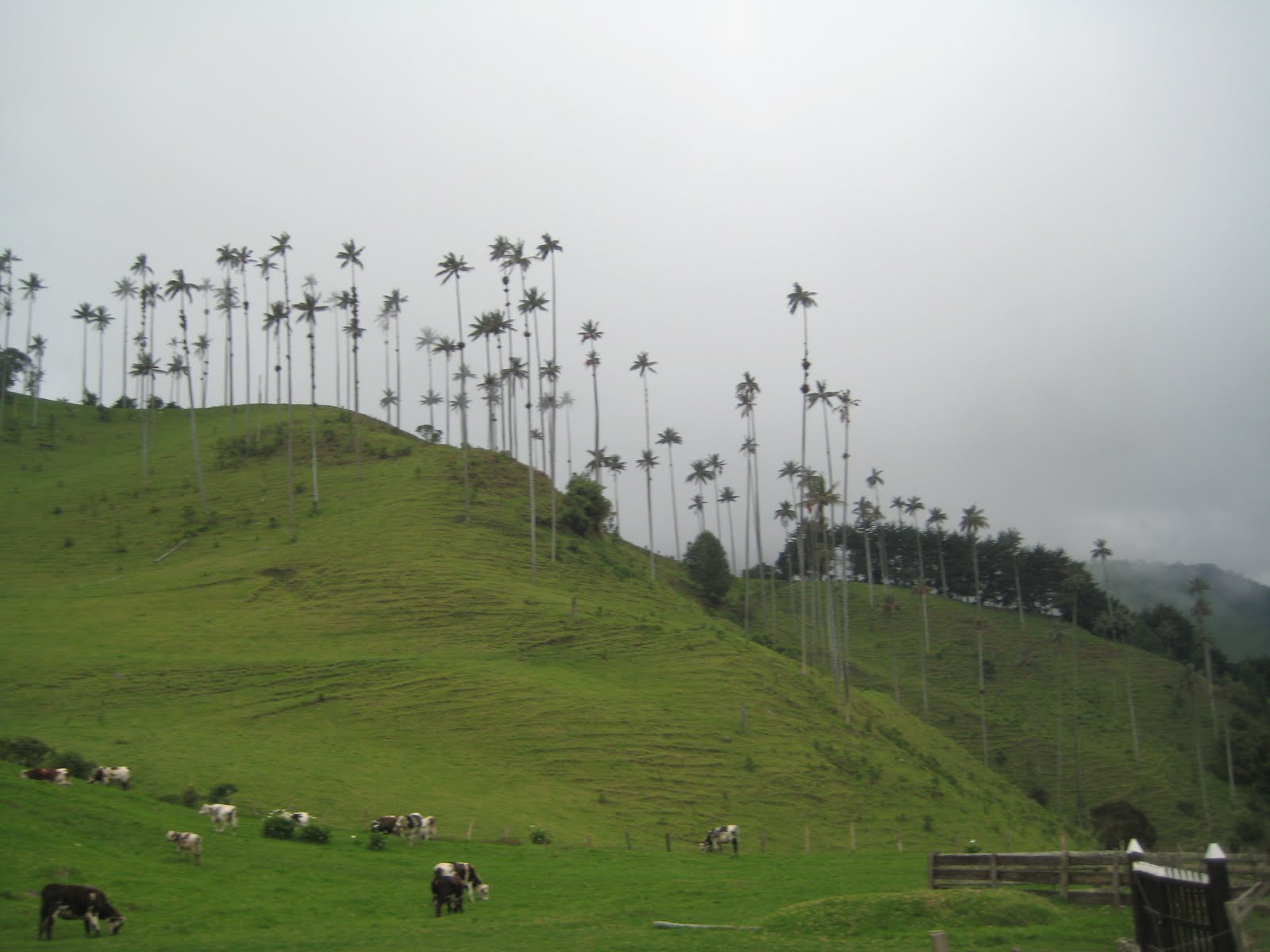
Quindío wax palms, Valle de Cocora
I spent the week around New Year's on a "finca" in Colombia's "Coffee Triangle" with friends from Spain & Colombia--talk about beautiful & relaxing! The finca was a large vacation house which the 9 of us easily fit in to;  we were so busy with the pool, jacuzzi, beach volleyball & enjoying the surrounding countryside that we never even got to use either of the two pool tables, the tree swing, or the soccer field which were also available. It was a working farm with cows--we had fresh milk, dogs, cats, rabbits, roosters (although we could have done without their early morning wake up calls) & even peacocks roaming the yard.

Great food & gorgeous views!
I was told that many of these vacation homes several years ago belonged to various drug lords who ruled the area. While in the past the average Colombian wouldn't have dreamed of vacationing in this area due to the drug lord and guerrilla activity, tourism is now booming. We visited the Cocora Valley, where 60 meter tall Quindío wax palms (Colombia's national tree) shoot above the cloud forest below--an amazing sight; floated in (& out of! :) a bamboo raft down a river; soaked in thermal hot springs; went under, through & behind water falls; strolled through Salento, a typical Antioquian town; toured a coffee plantation and tried our hands at picking coffee beans; and of course we ate very well!


Burning last year's woes...
For New Year's Eve itself, I was introduced to a few Colombian traditions. First we wrote down on pieces of paper things from the past year we wanted to leave behind; they were then all put in a pot in preparation for burning at midnight--get rid of all the bad from the 2011! Many people will make large dolls, dress them in clothing from all the family & stuff them with the "bad" from the past year to burn at midnight--our pot had a tiny doll representing this. In in our pockets we also had lentils to ensure a year of abundance and some kind of cash for financial security. At the stroke of midnight, we each ate 12 grapes, a tradition I'd been introduced to in Spain as well. I learned too late that I should have been wearing yellow underwear at midnight to bring wealth & prosperity in 2012!

Touring the coffee plantation.
After a week in the coffee zone, I returned to Bogota by car with my Spanish friends who are living in Bogota, an ~180 mile trip that took us a lightning fast 9 hours. As there is no train system in Colombia, all goods are transported by truck and passenger buses are also popular. Any goods arriving at Buenaventura, Colombia's Pacific port, arrive at the capital city by truck using the very route (ie, the only route) we were using to get to Bogota; buses between Bogota and the other main cities of Medellin and Cali use this road as well. The single lane highway climbs a mountain and is filled with hairpin turns; you can imagine how slowly these trucks laden with goods climb and how difficult it is to pass with all of the turns. So it's slow going....and an experience!! One of the pluses about this route, however, is the amazing scenery, although for our climb it was cloudy & rainy and we couldn't see much (this weather added to the excitement of the drive! :), but for the descent, the green countryside with its steep terrain was amazing.

A "fiambre" lunch wrapped in banana leaves during our bamboo raft trip
I'm in Bogota briefly before returning to Cartagena. The weather has been taunting me here with beautiful mornings & early afternoons--my friend's apartment has floor to ceiling windows with fabulous views of the mountains and is right near a great park, so at least for a couple of days I've been out "running" (& I use that term loosely). It's all making me wonder why I'm not living in Bogota....but once the rain starts in the afternoons & I hit traffic whenever we venture out, I remember why. Still, it's growing on me and I do have some great friends here, so I'll be back!


A few more photos of our week in the Coffee Triangle are here.

21 December 2011

Happy Holidays!

In the depths of the Salt Cathedral
I am back in the U.S. for a brief holiday visit but was able to enjoy a few sunny days in Bogotá before leaving!

I visited the Catedral de Sal (yes--salt!) in Zipaquirá, a 40 minute bus ride north of Bogotá. The town is kind of a smaller version of Villa de Leyva with a nice main plaza. Salt has been mined here since the 5th century BC and early miners had carved out a sanctuary as a place to pray before starting work. That developed into a larger "cathedral" in the latter half of the 20th century which ultimately was closed for structural reasons in 1990. A new "cathedral" (it is a functioning church but not an official cathedral) was built 200 feet below the old one, is 200 meters underground, and opened in 1995.
TransMilenio buses bypassing traffic!

To get to the bus station for the bus to Zipaquirá and to get around Bogotá (on the rare occasion I wasn't walking!), I took the TransMilenio, a bus system that opened in 2000 with dedicated lanes allowing buses to zoom by the traffic-packed roads. Even with these dedicated lanes, it can take 45 minutes to go from northern Bogotá to the old part downtown, so you can imagine what it's like in a taxi or car to get around with traffic.

Bogota's Plaza de Bolivar with Montserrate in the background
The Cathedral of Bogotá and several government buildings surround the Plaza de Bolivar in the old part of the city; just south of the Plaza is the Presidential Palace, or the Casa de Nariño. When I was there, there was a group displaying photos of people who had been detained and or killed, the woman I spoke to said by the government for suspicious reasons, although I don't know anything else about this. There were also of course many Christmas displays, a large banner protesting the FARC (likely leftover from the previous week's peace march), and on a couple of the government buildings there was still graffiti and paint ball marks from student protests that had been held in October and November. It's a Plaza that tells a lot of stories!

Top of Montserrate with Nativity lights & view of the city.
I took the funicular up to the top of Montserrate, 3100m/10,000 ft above sea level, where there's a church as well as great views of Bogotá. It's well worth it and I was glad to have a clear day to finally take advantage, although I've been told it's impressive no matter what the weather. With more time, I'd take the hiking trail next time. Once at the top, not only is there the church but also various restaurants (some looking more dubious than others as you can see in some of my photos), shops and for Christmas, a great light display of huge Nativity figures.

Bogotá: Jorge, from Madrid, & I met in NYC in 1990!
Although not a fan of the traffic and (in general) weather of Bogotá, one of the great things about the city is that I have some good friends who live there (& then am getting to know their friends too!). Not just my Colombian friends Olga & Gustavo & their families, but several friends from Madrid who live there--some I have known since I studied there in 1982 and one who I know from my time at CIEE NY. Funny how you can travel to different countries and continents and find friends you've known for a long time and met in other parts of the world! (All of my Bogota photos are here.)

Now getting ready for Christmas with family...I'll be returning to Colombia to celebrate New Year's with friends in the "Coffee Triangle" (an area in the middle of the country where--guess what? they grow coffee!--and which has been declared by UNESCO as a World Heritage site) where we'll be for a week. Then I'll be heading back to Cartagena--I've been offered an English teaching job at the "Centro Colombo Americano" & will start observing classes in early January before teaching my own starting in early February. Stay tuned for those adventures!

Happy Holidays!

08 December 2011

Written in rainy Bogotá

Wandering the streets of Villa de Leyva
I've (temporarily!) left Cartagena and am currently in the capital city of Bogotá, an hour+ flight from Cartagena but by bus it would have been ~18 hours (yes, I flew). I spent a great weekend in a small colonial town about 3 hours north of here called Villa de Leyva where a friend's mother lives (she has a cute little house that's available for rent if anyone wants to spend a few restful days here; see photos of the place here among my photos of Villa de Leyva). This area was always very desert-like but, as in the rest of the country, for the past couple of years it's been raining more than usual and so is greener, wetter, & not as warm as it used to be, but, as you can see in these photos, still beautiful and relaxing!

Holding a sign with photos of kidnap victims at the March for Peace
As you may know, there's a rebel army in Colombia called the "FARC" (a Spanish acronym for Revolutionary Armed Forces of Colombia) which has been around for years, in theory fighting for the poor in Colombia. I won't get in to the politics or the history--way too complicated and I don't (yet?) understand it all--but in the past several years the FARC has been on the decline. One of the main ways they finance their efforts has been to kidnap wealthy citizens and hold them for ransom; they've also captured many police and soldiers to use them as a bargaining chip. In late November, four of the police/armed forces being held hostage were killed by the FARC when the army came across them. In response to the hostages being killed, social organizations here called for a country-wide (& later international) march for peace and freedom for hostages for December 6. I was able to participate in the march here in Bogota on Tuesday; there were many signs and banners showing photos and brief histories of those who have been kidnapped and are either still held or were killed. My photos are here and a good read with photos from another blog is here. People I've met here have had family members kidnapped; some were held for a few days, others for many months. I've read a couple of books written by hostages (3 US contractors and Ingrid Betancourt, former politician) who were held for 6 years in the Colombian jungles. It is difficult to imagine to say the least.

Noche de Velitas with Laura, Olga, Gustavo (via Skype!), Norell, me (& our photographer Angie!)
On a lighter note, last night the Christmas season officially started in Colombia with the "Noche de Velitas" or "Night of the Little Candles" on December 7 (the eve of the Feast of the Immaculate Conception, December 8). Everyone lights little candles and carries them around, "plants" them in parks, in doorways, on the sidewalks, wherever. We wandered around the streets of Bogota admiring the candlelight and holiday lights on the streets and in the various parks, returning "home" to light our own candles!

My friend Olga has been making sure I get to taste all of the traditional Colombian foods, from the various types of arepas (a bread-like thick pancake stuffed with egg, cheese, or meat, etc) to the delicious main meals of stews, meats, rice, etc. The type of food served varies from region to region and there are often various versions of the same dishes. And yes, all have to be tried!

Eating well with Olga in Bogota!

01 December 2011

Food in a bag

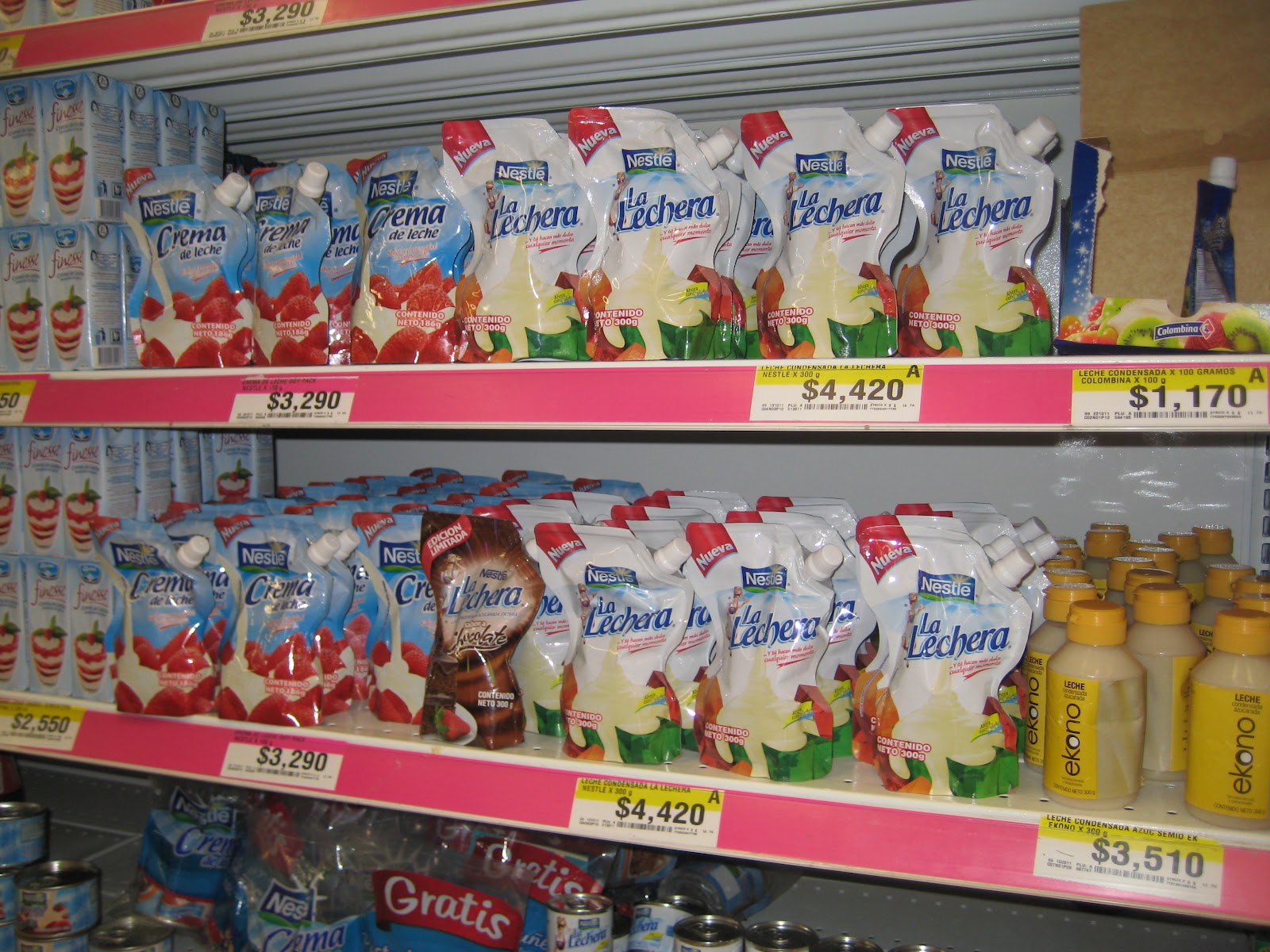
I never thought about packaging ketchup in a bag before, but why not? It's like those ketchup packets you get at McDonald's, only on a larger scale, right? And if it works for ketchup, why not mayonnaise & mustard? Sour cream? And milk for that matter (which I'll admit I have seen before). Not just whole, 2% and skim, but condensed milk too. Be creative! Bag your water, your lotion, and your liquid soap while you're at it. It's convenient and space saving! The mayo, ketchup, etc., have spouts you can close; the milk, yogurt drinks and water don't. I'm working on a good system for those once opened, but so far binder clips are key.

Condiments!

Milk

Many of you know my aversion to buying water; however I was advised not to drink the tap water here. I had been boiling water but I couldn't keep up with my own thirst!

Ice cream sauces

Yogurt drinks.

OJ
Oatmeal, a very popular item (there's also milk with oatmeal, yogurt with oatmeal....)

Sour cream & alioli

Condensed milk, chocolate even!

Stuff in a bag: lotion

Stuff in a bag: liquid soap


Stuff in a bag: floor wax